
Analytics Maturity Assessment
Most organizations describe the past with data. Few use it to shape the future.
The Planaletix Analytics Maturity Assessment (AMA) evaluates an organization's analytics programme capability across ten critical dimensions derived from leading international analytics standards, GCC regulatory frameworks, and documented GCC analytics market intelligence. The AMA Assessment provides a scored maturity profile, GCC regional benchmarking, dimension-level interpretation with recommended actions, and a prioritized analytics programme improvement roadmap.
Analytics maturity is the single most important determinant of whether an organization captures value from its analytics investment. Across GCC markets, the gap between analytics capability (what organizations can produce analytically) and analytics impact (whether those outputs improve decisions and generate measurable business value) represents the most prevalent and most expensive analytics programme failure. The AMA Assessment is specifically designed to diagnose this gap and provide the evidence base for targeted improvement investment.
The framework evaluates analytics maturity from four perspectives — the ten dimensions are classified by category (Technology, Process, or People) — ensuring that no single investment vector dominates the maturity picture and that the assessment captures the organizational and human dimensions of analytics programme effectiveness alongside the technical ones.
Target Audience
-
Chief Data & Analytics Officers (CDAOs) and Analytics Directors — requiring a comprehensive, independently structured maturity baseline and a GCC-benchmarked view of their programme gaps relative to sector peers and global leaders.
-
Chief Digital Officers and Chief Information Officers — evaluating the analytics component of their organization's digital transformation programme and seeking a structured view of analytics maturity as a digital capability dimension.
-
Chief Executive Officers and Managing Directors — seeking an independent evaluation of their organization's analytics programme quality, commercial accountability, and competitive positioning in the GCC analytics market.
-
Chief Financial Officers and Finance Leadership — requiring documented analytics ROI measurement, portfolio performance evidence, and investment justification for analytics programme budgets — particularly for board and audit committee reporting.
-
Chief Risk Officers and Audit Committees — requiring an independent assessment of analytics programme risk — including model risk, data quality risk, algorithmic bias risk, UAE PDPL compliance risk, and the risk of analytics-driven decisions producing unintended consequences.
-
Board of Directors and Investment Committees — across GCC financial services, energy, telecommunications, government, and healthcare sectors where analytics programme quality is a board-level governance responsibility and a material determinant of organizational performance.
-
Government entities and Sovereign organizations — across the GCC pursuing UAE AI Strategy 2031 and GCC digital economy objectives, and requiring structured assessment of analytics programme maturity across their organizational portfolios.
-
Private equity firms and strategic investors — requiring analytics capability assessment as part of technology-enabled business due diligence, portfolio operational improvement evaluation, and value creation planning for GCC digital assets.
-
Analytics and data teams initiating a maturity baseline — seeking a structured, evidence-based starting point for analytics programme improvement planning, governance design, and investment prioritization.
-
Consulting and advisory firms — serving GCC clients in analytics programme design, governance, and transformation, who use the AMA Assessment as a structured diagnostic and client engagement tool.
Alignment with International Standards

The assessment framework draws from and aligns with the following international standards and frameworks:
-
DAMA DMBOK v2 (Data Management Body of Knowledge, Second Edition) — The primary reference for data management maturity concepts underlying D2 (Data Readiness & Quality), D3 (Analytics Architecture), D4 (Business Intelligence), D7 (Analytics-Driven Decision Making), and D10 (Value Measurement & ROI). DAMA DMBOK v2's 11 knowledge areas — including data governance, data quality, data architecture, metadata management, and master data management — form the data management backbone of the AMA framework.
-
TDWI Analytics Maturity Model (Transforming Data With Intelligence) — Primary reference for the five-level analytics maturity structure, dimension weightings, and maturity level descriptor calibration across all AMA dimensions. TDWI benchmarking data is a primary source for GCC-regional analytics maturity benchmarks, particularly for D1 (Strategy), D4 (BI), D5 (Advanced Analytics), D6 (Talent), D8 (DataOps), and D10 (Value Measurement).
-
Gartner Analytics and BI Maturity Model — Reference for D4 (Business Intelligence & Reporting), D5 (Advanced Analytics, AI & ML), D7 (Analytics-Driven Decision Making), and D8 (Analytics Operations & DataOps) dimension design and maturity level calibration. Gartner Magic Quadrant BI and Advanced Analytics research informs GCC benchmark values across the relevant dimensions.
-
MIT CISR Digital Platform Framework (MIT Center for Information Systems Research) — Reference for D7 (Analytics-Driven Decision Making) and D10 (Analytics Value Measurement & ROI). MIT CISR research on the commercial value of data-driven decision making and the role of analytics in digital platform performance underpins the D7 weight rationale and the D10 ROI measurement approach.
-
UAE Artificial Intelligence Strategy 2031 (Federal Government of the UAE) — National strategic framework that AMA Level 4–5 descriptors align with. Organizations at Level 4–5 analytics maturity contribute to UAE AI Strategy 2031 objectives for national AI capability development, analytics talent development, and the UAE's ambition to be among the top AI-ready nations globally. Relevant to D1 (Strategy), D5 (Advanced Analytics & AI), D6 (Talent), and D9 (Ethics & Compliance).
-
UAE Federal Decree-Law No. 45 of 2021 — Personal Data Protection Law (UAE PDPL) — Applicable to all analytics workloads processing personal data of UAE residents. Governs D9 (Analytics Ethics, Privacy & Compliance) privacy compliance sub-dimensions including Privacy Impact Assessment requirements, data subject rights, automated decision governance, data residency, and data retention. Also relevant to D2 (data retention governance) and D3 (analytics security and access control).
-
DIFC Data Protection Law No. 5 of 2020 (DIFC DPL) — Applicable to organizations operating within the DIFC free zone or processing DIFC customer personal data in analytics workloads. Referenced in D9 privacy compliance sub-dimensions and data residency governance requirements for cloud analytics workloads. Considered alongside UAE PDPL for organizations with DIFC regulatory obligations.
-
ADGM Data Protection Regulations 2021 (ADGM DPR) — Applicable to organizations operating within the Abu Dhabi Global Market free zone. Referenced alongside UAE PDPL and DIFC DPL in D9 privacy compliance dimensions for organizations with multi-jurisdiction GCC data protection obligations.
-
Saudi Arabia Personal Data Protection Law — Royal Decree M/19 (2021, effective 2023) — Applicable to organizations processing personal data of Saudi residents in analytics workloads. Referenced in D9 cross-border data transfer governance, data residency compliance dimensions, and consent management requirements for analytics workloads touching Saudi customer data.
-
ISO/IEC 42001:2023 — Artificial Intelligence Management Systems — International standard for AI management system governance. Referenced in D5 (Advanced Analytics, AI & ML) Level 4–5 descriptors as the certification that demonstrates enterprise-grade AI governance quality, and in D9 (Analytics Ethics, Privacy & Compliance) responsible AI governance dimensions including AI risk management, algorithmic transparency, and AI system auditing.
-
NIST AI Risk Management Framework 1.0 (NIST AI RMF) — The US National Institute of Standards and Technology's comprehensive AI risk management framework. Its four core functions — Govern, Map, Measure, Manage — underpin Level 3–5 AI governance descriptors in D5 (Advanced Analytics) and D9 (Analytics Ethics). The NIST AI RMF is widely referenced by GCC organizations as the operational governance framework for responsible AI deployment.
-
OECD AI Principles (2019, updated 2023) — The foundational international framework establishing shared principles for responsible AI governance, including inclusive growth, human-centred values, transparency, robustness, and accountability. Referenced in D5 (Advanced Analytics) and D9 (Analytics Ethics) Level 4–5 governance descriptors as the international consensus framework that GCC AI governance is expected to align with.
-
PwC Global Data & Analytics Survey — Biennial research publication covering data and analytics programme maturity, investment patterns, and ROI across global markets including GCC financial services, energy, and government sectors. Primary source for GCC analytics programme benchmarks supplementing TDWI and Gartner for GCC-specific market calibration.
Assessment Scope
The AMA Assessment evaluates analytics programme maturity at the organizational level — encompassing all analytics activity within the organization's operational footprint, including centralized analytics functions, federated business unit analytics teams, contracted analytics services, and cloud analytics platforms where the organization holds governance accountability.
The assessment applies to all GCC organizations that invest in or intend to invest in analytics as a business capability driver — including commercial organizations across financial services, energy, telecommunications, retail, and healthcare; government ministries and authorities; sovereign wealth funds and investment vehicles; and public sector entities pursuing UAE AI Strategy 2031 and GCC digital economy objectives.
The AMA Assessment is analytics-programme-wide in scope rather than use-case-specific. It evaluates the organizational infrastructure — governance, data, architecture, talent, operations, ethics, and value measurement — that determines whether the analytics programme can reliably deliver value across the full range of analytical use cases, from basic business intelligence reporting through to production artificial intelligence and machine learning.
The online self-assessment is designed to be completed by the individual or small team with the most comprehensive view of the organization's analytics programme — typically the CDAO, Analytics Director, or a senior analytics manager who understands governance, data, technology, talent, and value measurement dimensions across the organization. Responses should reflect the current organizational reality rather than planned or aspirational capabilities.
ASSESSMENT PHILOSOPHY & DESIGN PRINCIPLES
The scoring framework is built on six design principles that ensure rigor, fairness, and actionability
Principle 1: Evidence-based scoring.
Each dimension is assessed through ten scenario-anchored questions with five maturity-anchored answer options. Respondents select the description that most accurately reflects their current organizational reality rather than their aspirations. The scoring model is resistant to aspirational self-assessment because each answer option describes a specific, verifiable organizational condition.
Principle 2: GCC market calibration.
Dimension weights, GCC benchmark scores, and dimension narratives are calibrated to the GCC analytics market — specifically UAE, Saudi Arabia, Qatar, Kuwait, Bahrain, and Oman. Benchmarks are derived from TDWI Analytics Maturity benchmarking, Gartner Data & Analytics Programme maturity research, MIT CISR digital platform surveys, PwC Data & Analytics Survey, and Planaletix advisory experience across the GCC market.
Principle 3: Governance-first architecture.
The two highest-weight dimensions — D1 Analytics Strategy & Governance (14%) and D2 Data Readiness & Quality for Analytics (14%) — both carry Critical Threshold status. This reflects the practitioner finding that ungoverned analytics and unreliable data are the two most common root causes of analytics programme failure in GCC organizations, independent of investment level or tool sophistication.
Principle 4: Commercial accountability orientation.
Every dimension interpretation includes documented advancement criteria, recommended actions with commercial rationale, key risk narrative, and advancement pathway to the next level. The framework is designed to drive investment decisions, not merely describe the current state.
Principle 5: Regulatory alignment.
The framework is explicitly aligned with UAE Federal Law No. 45 of 2021 (UAE PDPL), DIFC Data Protection Law 2020, ADGM Data Protection Regulations 2021, Saudi Arabia Personal Data Protection Law, UAE AI Strategy 2031, ISO/IEC 42001:2023, and NIST AI Risk Management Framework 1.0. Compliance obligations are embedded in the assessment rather than treated as a separate domain.
Principle 6: Technology-agnostic methodology.
The AMA Assessment evaluates analytical maturity outcomes — what the organization can do, reliably and at scale — rather than the presence of specific technology products. Organizations with sophisticated tooling but poor governance consistently score lower than organizations with modest tools and disciplined analytical practice.
ASSESSMENT DIMENSIONS
100 structured questions. Weighted scoring. Benchmarked against your sector and region.
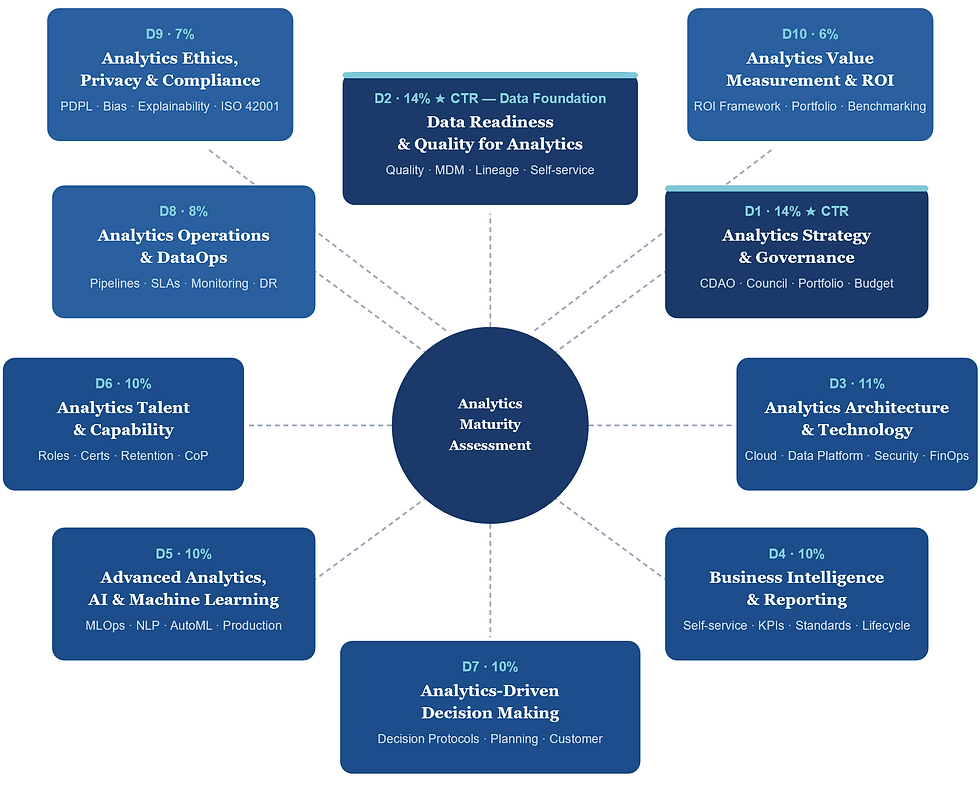
D1 - Analytics Strategy & Governance [14%]
D2 - Data Readiness & Quality for Analytics [14%]
Assesses whether analytics is directed by formal strategy, executive accountability, active governance, investment oversight, standards, and risk management. As a Critical Threshold dimension, weak governance prevents coordinated, sustainable, and measurable analytics programme execution.
Measures whether data is reliable, integrated, catalogued, governed, and analytically fit across critical domains. As a Critical Threshold dimension, poor data quality undermines trust in every dashboard, model, and analytical decision regardless of technology sophistication.
D3 - Analytics Architecture & Technology [11%]
D4 - Business Intelligence & Reporting [10%]
Evaluates whether the analytics platform is scalable, secure, resilient, standardized, and architecturally governed across ingestion, storage, processing, and consumption layers. Low maturity creates fragmentation, technical debt, rising costs, and delivery constraints that limit future analytical growth.
Assesses whether reporting, dashboards, metrics, and self-service BI are standardized, governed, trusted, and widely adopted. Strong BI maturity ensures analytics reaches decision-makers consistently, while weak governance creates conflicting metrics, low trust, and poor business adoption.
D5 - Advanced Analytics, AI & Machine Learning [10%]
D6 - Analytics Talent & Capability [10%]
Measures the organization’s ability to build, govern, deploy, and scale predictive, prescriptive, and AI-driven analytics. Low maturity traps organizations in pilots without production value, while mature capability enables automation, forecasting, optimization, and sustainable competitive differentiation.
Evaluates whether the organization has the roles, skills, certifications, development pathways, and retention mechanisms required to sustain analytics delivery. Low maturity leaves programmes dependent on scarce individuals and limits returns from investments in data and technology.
D7 - Analytics-Driven Decision Making [10%]
D8 - Analytics Operations & DataOps [8%]
Assesses whether analytics is embedded into real decision processes across strategy, operations, customer management, and risk. Maturity is proven when evidence consistently shapes actions, not merely when reports are produced and acknowledged without influencing outcomes.
Measures how reliably analytics services run through monitoring, SLAs, testing, incident management, release control, and recovery planning. Low maturity creates fragile pipelines and constant firefighting, reducing business trust and preventing analytics capability from scaling effectively.
D9 - Analytics Ethics, Privacy & Compliance [7%]
D10 - Analytics Value Measurement & ROI [6%]
Evaluates whether analytics and AI are governed ethically, lawfully, and transparently through privacy controls, bias assessment, explainability, and compliance processes. Strong maturity protects trust and regulatory standing while enabling responsible use of sensitive data.
Assesses whether analytics investments are linked to measurable business outcomes through ROI frameworks, benefits tracking, portfolio reporting, and optimization. Without value measurement, analytics remains vulnerable to budget pressure because impact is asserted rather than evidenced.
MATURITY MODEL: FIVE LEVELS DEFINED
One Honest Score. A Clear Roadmap Forward.
GCC benchmark programme, certified, research-linked, standards-shaping, regulator-recognized.
Optimized
Quantitatively managed, ROI-driven, cloud-scaled, validated, and regionally recognized.
Managed
Governed analytics programme with standards, production models, and measurable outcomes.
Defined
Basic capabilities exist, but governance, standards, scalability, and measurement lag.
Initial
Ad Hoc
reactive analytics with no strategy, governance, standards, or impact.
Executive Deliverables
-
Executive Summary & Priorities
-
Maturity Profile
-
Per Dimension findings
-
6-12 Month Action Plan
-
Sector & Regional Benchmarking
Action Plan
-
Top 5 priorities ranked by impact & urgency
-
Capability roadmap
-
Governance, operating model.
-
Resourcing recommendations
-
Use-case identification and recommendations


